Blog - foXnoMad

How Long Do You Stay Offline When Traveling?

orange tabby cat sleeping in sunThere used to be two diverse positions when it came to online connectivity while off traveling. Some people were completely disconnected whereas the others lugged around the ancient versions of 5 kilo laptops. Now we’ve got phones, digital guidebooks, and laptops thinner than a fat piece of paper, making it hard to escape the web, no matter where we are.

Including email, Facebook, and Skype: When you’re traveling, what’s the longest you go without being online at all?

As you might imagine, my answer is less than 3 hours when I’m awake, on average. And since I’m always traveling, that’s pretty much all the time. Most of my Internet hours revolve around foXnoMad in some way, although I’ll likely be getting two hands or four soon to help out. Still, I imagine I’ll be online more often than not; though I think I may not be the only one with a travel online addiction habit. I’d be interested to hear how much – or little – you’re in cyberspace when traveling in the comments below! I’ll share some of your responses in an upcoming post – or therapy session.

Pictures From The Sightly Site Of Steep Erosion: Sleeping Bear Dunes

Several weeks ago I was invited by GMC to preview their 2013 Terrain Denali in Traverse City, Michigan. I’m offered many trips so what especially caught my eye about this one was that I had never heard of Traverse City before. I figured if this is the area GMC selected to invite a group of journalists and bloggers to drive their upcoming car models it must be worth seeing.

One part of a smooth driving day was seeing Sleeping Bear Dunes National Lakeshore, a live geology lesson along 60 kilometers (~35 miles) of northwestern Michigan coastline. The sands are the front line in an epic battle between two of nature’s most powerful forces: wind and waves.

bear dunes scenic turnout

The dune was formed 2,000 years ago, the result of glaciers from the last Ice Age melting 12,000 years ago [PDF]. Today it is kept alive, partially, by Michigan Lake’s stubborn winds pushing back off the water. On the drive up to the dunes themselves you can see of how high the glacier elevation was and how quickly vegetation rushed in to fill the void of ice and water.

sleeping bear national dunes lakeshore forest

Further up the serene driving trail, to the edge of the dunes where the sands drop a steep 140 meters (~450 feet) down.

sleeping bear dunes

This is the view of Sleeping Bear Dunes from off the pier shown above. To give the picture some perspective, there is a couple walking along the shoreline, can you see them?

sleeping bear dunes

There is but one way to get down to the shore from here…and only one way to get back up. It’s not for the lighthearted or light-walleted either, there are signs along the path warning you that that rescues aren’t free.

sleeping bear dunes climb

So think twice before going down or only follow someone big enough to carry you back up.

sleeping bear dunes

In this struggle between land, air and water, the sand is slowly losing to the power of the waves below. Every 10-15 years large chunks of land spill down below as the dunes, with no vegetation to support them, are swiftly (geologically speaking) eroding.

people at sleeping bear dunes

What was just as surprising to me is how few people, outside of Michigan, actually visit Sleeping Bear Dunes National Lakeshore. (Around a million tourists annually with most being Michigan residents.) I’m convinced if Michigan were its own country, more travelers would go out of their way to see such an impressive sight. (Or even just know about it.)

sleeping bear dunes

Entry into the Sleeping Bear Dunes National Lakeshore is $20 and there’s more to see than the dunes themselves. It’s also a popular surfing area and boating area so distracting that if it weren’t for the Denali’s lane departure warning, I probably would have driven it off the road. And gotten lost without the GPS. Though I still think it was a shame not to have loaded a sandboard before leaving Traverse City, there was plenty of room in the back, as well as in my distorted imagination.

The Best And Worst Ways To Look For Cheap Flights

airplane wing detroit metro airport

Looking for and finding the cheapest possible flights is hardly a science but more an obscure dark art with many interpretations among its disciples. I’m asked routinely what’s the cheapest flight from one place to another and I’m sorry to say there is no magic formula – even for us frequent travelers. However – a big however – if you’re willing to set aside some time, effort, and a cup of coffee, a new world of deals may be laying just beneath your keyboard.

You Need To Do The LegFingerwork

Sadly, there isn’t some nirvana of free flights hiding out there on the Internet. (If I find it I’ll let you know.) Discovering one of the better deals on airfare for your specific route requires some digging and the biggest mistake you can make is only using one search engine.

Before we begin, start off by opening two separate web browsers on your computer. For example Firefox and Chrome (don’t just open up two tabs on the same browser.) Put your primary browser – the one you use daily – off to the side until you’re ready to book. During the searching phase use your alternate web browser as there is anecdotal evidence the airlines may be using cookies to charge you more.

Airfare Search Engines For Major Airlines

For major airlines and cities, begin with my personal favorite, Kayak; which searches several hundred travel sites at once. Kayak will give you a good baseline price to work with and you can continue looking from there.

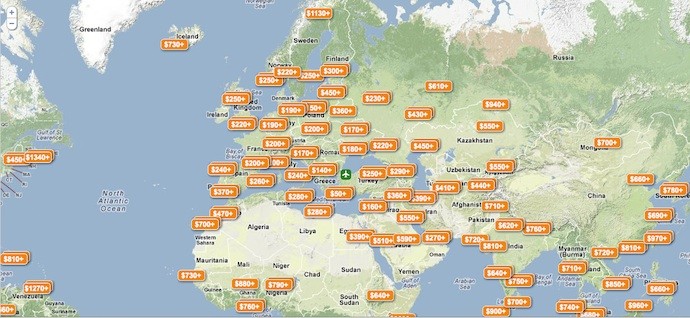
kayak explore

  • Google Flight Search – It tends to use information directly from the airlines’ own sites often results in fares about 10% lower than baseline; unfortunately it’s Canada and U.S. originating flights only.
  • Hipmunk – An intuitive interface for sorting through multiple flight schedules.
  • FareCompare – Selective search of other aggregators like Priceline, Expedia, and Vayama.
  • Orbitz – Particularly better rates when booking with upper-budget accommodation.

hipmunkOnline Search Tools For Budget Airlines

  • AirNinja – Specializes in low-fare routes.
  • Fly Low Cost Airlines – Terrible interface but finds routes and connects you to low cost carriers directly.
  • Momondo – Not specifically for low cost carriers but its searches cast a wide digital net.

Once you find a price and route that suits you with any of these search engines, go around them when possible by heading to the airline or final booking site directly in your other browser. (To get around tacked on commissions.) When you’ve got time to plan, set up price alerts using Yapta which will notify you if ticket prices fall – effective after you purchase as well for any due refunds.

Use the local version of airline websites to uncover discounts on international flights. Say you’re booking a flight on Air France from the United States, it doesn’t hurt to search for tickets using the French domain of their site (http://airfrance.com/ vs. http://airfrance.fr/). There are no guarantees you’ll get lower fares, but 1 extra minute of your time could produce savings.

anil polat on mobileGoing One Step Beyond Traditional Searches

Airfare search engines are certainly useful but they’re designed to give you the most straightforward booking experience, which doesn’t always result in the lowest fares. You can manually improve the process by using multi-city flights to save on airfare. Picking up the phone and calling the airlines often uncovers special promotions not likely to be picked up by aggregators. (Use GetHuman or Contact Help to get quickly through automated prompts.) RetailMeNot is also a good resource to find discount codes.

Finally, Money Talk News suggests searching for one seat at a time as the airlines will show you the most expensive rates by default. They recommend always doing searches for a single traveler initially to get the lowest airfare per seat class.

Use Your Frequent Flyer Miles With Borg Efficiency

You don’t need to fly very much – or sometimes at all – to accumulate frequent flyer miles. Those bonus points aren’t just for free flights either, aside from upgrades they can get you hotel rooms, car rentals, retail discounts, and more.

borg las vegas star trek convention

Credit cards are the most common path to large batches of bonus miles but you can still foster an impressive stash without relying on plastic. You should also encourage your family and friends who travel to open up alliance accounts – they might not use those miles but could be kind enough to transfer them to you. Better yet – have them book a flight for you directly from their award account so you don’t have to pay any mile transfer fees. (And then don’t forget to thank your mom!)

georgian pig mtskhetaBook At The Right Times By Blasting Prevalent Myths

Rumors like booking on Tuesday nights are prevalent but there isn’t much data to support such specific booking windows for low fares. According to the New York Times, how early or late you should book varies based on the time of year and destination. In general, they found booking 24 weeks in advance was a sweet spot for lower airfare. I don’t know about you, but pigs are more likely to fly out of my butt before I book that far in advance so luckily the next windows are before airlines are tend to raise fares. Those are 22, 15, 8, and 4 days before you intend to fly.

Other Ways To Use The Calendar To Save

  • Try To Travel On The Following Days –  Flying on Wednesdays, Saturdays, and Mondays can often save you on airfare as there’s less demand for tickets on those days.
  • Check For Tickets More Than Once In A Day – airfarewatchdog notes airlines change fares several times a day. Check back more than once in 24 hours and you could find yourself saving a few dollars.
  • Fly Very Early, Late, Or Accept Hellish Layovers – It’s cheaper because not many people are not willing to make the trade between cost and travel comfort.

Bing’s Farecast can also guide you to better purchasing times by letting you know whether the routes you’re searching for are likely to get more expensive or go down in price in the coming weeks.

Calculate Final Costs And Know When To Quit

Remember that airfare search engines and the airlines may hook you with deceptively lower prices that don’t include fees until you’ve got your credit card out and are about to hit “purchase.” (That’s again where two browsers can come in handy.) Luggage Limits (original post) clues you into baggage fees and Kayak has a nice list of other things airlines may charge you for.

Though, as I mentioned at the beginning of this post, there is no free flight out there for you to find. What exists is a lower limit on how much you can save, depending on how flexible your travel plans are. Give your low airfare search a good effort and know when to stop chasing cheap tickets to really save on your next vacation.

What are some of the tricks you use to save on airfare?

Why Does Wireless Internet Access Suck In Western Europe?

big ben london england

Travelers visiting Western Europe are often impressed with the orderliness of its people, efficiency of their governments, and cleanliness of the streets. Western Europe has 7 of the world’s richest countries and 9 of the fastest download speeds anywhere. Then why is finding free wireless access so difficult in places like Germany, France, and Spain?

That is a complicated question – every country has a unique make up – but there are some general reasons why you’ll find yourself walking a lot farther in Munich than Bucharest to find a cafe with free wifi.

Reichstag berlin germanyWhy GDP Matters…And Doesn’t

How rich a country is doesn’t correlate with how fast its Internet speeds are. Just look at Romania, whose connection is more than twice as fast as America’s, despite only earning 1% their gross domestic product (GDP). Or Moldova, a country that makes less revenue per year than Haiti yet has download speeds faster than England. But it’s not really Internet speed that matters when it comes to free wireless access.

What’s more important is how many people in a given country have access to an Internet connection – something that has more to do with geography than money.

The Internet Goes Where People Live

A nation’s GDP loosely correlate with higher Internet penetration; the number of people in a country with access to the Internet. Countries like Iceland, Sweden, Australia, and Denmark are all at the top of global rankings when it comes to residents online per capita. Romania and Moldova on the other hand, have broadband penetration rates of about 14 and 40% respectively.

people in baku

All of these countries mentioned above however have some of the lowest population distributions in the world. What separates them in terms of Internet access rates is national income. The richer the country and lower the population distribution in a given country, the higher percentage of its citizens you’ll find have access to high speed Internet.

Low population distribution – that is, people not being spread out in a country – makes it cheaper for telecoms to set up their backbone infrastructure, which is typically their biggest expense. Having a high standard of living gives people enough income to get online. Having them in one place often means more bandwidth to go around. What separates Western Europe’s anemic free wireless landscape from places like southeast Asia is policy, not technology.

lol cat not laughingTaxes Ain’t Cheap And No One Gives A Bleep

Belgium, Finland, and Denmark are all wealthy with low population concentrations and high Internet penetration; but what keeps free Internet out of many their cafes is taxes. Those countries, along with their neighbors in Europe, also happen to have the highest tax rates in the world. Universal taxes on utilities, like the Internet, are common. For example, Germany’s Internet flat tax is around 25 Euros per month. Bulgarians, whose air is filled with the sweet waves of costless Internet, don’t have such a tax. They also pay the lowest rates in the European Union. (And many just don’t pay taxes.)

Aside from being expensive, there’s less economic incentive for businesses to spend money on free wireless. In general, about 6 times more people in Western Europe have broadband on their mobile phones than anywhere else in the world. In fact, the richer the country, the more people have fast Internet on their cell phone.

The Perfect Storm For Crap Connections In West Europe For Travelers

Restaurants, public buildings, and cafes aren’t as likely to pay an extra amount of cash to provide a free Internet connection in places where their patrons are happily checking Facebook on their phones. So while it’s not impossible to find free wireless in Western Europe, it can be difficult for economic reasons that are initially a bit counter-intuitive. Rich European countries may have the means to get online, but high taxes and low demand mean you might be suffering from wifi withdrawal next time you travel to Europe’s west.

A Visual Walk Through The Mud Volcanoes Of Gobustan, Azerbaijan

The mud volcanoes located in Gobustan National Park, about a 90 minute drive southeast of Baku, Azerbaijan, look like simmering pots of something you’d find on Voldemort‘s kitchen stove. Audibly they sound like the casually burping and discretely farting relative we all have in our families, although Gobustan’s mud volcanoes don’t smell like sulfur that’s been sitting in someone’s intestines for hours.

In fact, these “volcanoes”, caused by heated water and (mostly) methane gas rising above the Earth’s crust, don’t smell at all. The mud volcanoes in this UNESCO World Heritage Site simply bubble, dry, and move on to form a unique landscape.

gobustan national park

Although these mud volcanoes are usually a mellow bunch, quietly bubbling all day and night, every so often one of them explodes over several meters high, the flammable gases often igniting. I unfortunately didn’t get to see such a show but it gave me a better idea of where the name mud volcanoes comes from.

gobustan mud volcanoes

There are around 400 mud volcanoes throughout Asia and over half are located in Azerbaijan, a country that has 2% of the world’s natural gas reserves. 2% might not seem like a lot, but that amount of natural gas – approximately 6 trillion cubic meters – puts Azerbaijan 7th in the world. (Despite being the 114th largest county on the planet.)

gobustan mud volcanoes azerbaijan

When I arrived close to sunset, I was the only person among the mud volcanoes (aside from the driver waiting to take me back to Baku). I turned into a little kid as the dried mud is soft and fun to bounce around. Or ideal for some mud volcano surfing on if you’ve got no shame to release your inner-child. (I certainly don’t.)

gobustan mud volcanoes

Much like Oman, a destination you should visit before it becomes a hit, Gobustan feels like a science-fiction movie set. Paint it red and you too may just feel like you’re on the surface of Mars – which actually might have its own mud volcanoes.

gobustan

Despite its boiling appearance, the mud isn’t bubbling due to high liquid temperatures; in fact, the fluids are only about 2 degrees Celsius (3.5 F) warmer than the surrounding air.

mud volcanoes

Entry into the park is free, although getting there requires having your own car as there is no public transportation to the isolated mud volcanoes.

gobustan state reserve

The Gobustan State Reserve also contains rock art spanning about 40,000 years of human history which nightfall denied me a glimpse of. Though my late arrival did, I believe, add to my fondness of Gobustan’s mud volcanoes. Being the only one there made it feel more remote and exceptional than they might have with crowds of other tourists around me. Mars, and other tourist sites, often feel more alien the fewer other astronauts there are around you.

8 Peculiar Facts For Your (Rather Odd) Introduction To Moldova

moldovan flag

Squashed between Romania and Ukraine in eastern Europe, not too many people around the world know much about Moldova. For me, it’s a place that’s weird and quirky with a disproportionate amount of gorgeous people, within a general population that’s enjoys regular intoxication. There is something fundamentally unique about Moldova in a European alternate-universe sort of way.

Sure, you could learn about Moldova from a tourism brochure or something equally bland but there’s no better introduction than all of the randomly unifying characteristics that make it so interesting. Characteristics that most Moldovans – a people whose practicality arises from hard realities – accept and embrace in varying degrees.

1. The Capital Chisinau Is Not Pronounced “Chisinau”

chisinau cathedral

I’m glad several people told me this before I went around asking folks about “Cheesy-new”. Chisinau is actually pronounced like, “Kishi-now”, the confusion stemming from the crude translation of Latin characters from Romanian to English.

2. Moldovan Is Actually Romanian

chisinau market

Speaking of Latin script and languages, Moldovan is Romanian – sort of. In 1939 the language’s alphabet was converted to Cyrillic, a move by the Soviets to distinguish (and divide) the Moldovan ethnic group from Romanians. Shortly after Communism fell in 1989, the Moldovan government passed a law switching the alphabet back to Latin script. Moldovans themselves though are still roughly split as to whether they speak “Moldovan” or Romanian.

3. Parts Of Moldova Used To Be Romania In The Mid-1800s

bucharest art

The land that makes up current Moldova has seen a number of conquerors, rulers, and kingdoms vie for its strategic position (mostly) in between the Dniester and Prut Rivers. Aside from being a part of the Romanian nation state (Romanian United Principalities), modern-day Moldova was also once a vassal state to the Ottoman Empire and part of the Russian Empire.

4. Europe’s Largest Jewish Cemetery Is In Chisinau

chisinau jewish cemetery

Prior to World War II, Moldova had one of Europe’s largest Jewish populations. Although many fled before the Germans arrived, nearly 60,000 Jews were killed during the Holocaust in Moldova; sadly, more than 23,500 are buried in this cemetery on the outskirts of Chisinau.

5. Moldova Has A Break Away Territory

subway tunnel moldova

Transnistria, which sits just on the other side of the Dniester in what is officially Moldova, declared its independence in 1990. It is not officially recognized by any country in the United Nations (UN) and since the end of the War of Transnistria in 1992, has held a de facto independent status. Travelers can however visit Transnistria from Moldova (a day trip) but you’ll need your passport to cross the border.

6. Moldovans Drink More Alcohol Than Anyone Else In The World

red wine moldova

As I mentioned on my Facebook page, this is probably one of the reasons I enjoyed Moldova so much. As far as their drink of choice, Moldovans are fairly even split across beer, spirits, and wine…which brings me to my next point.

7. The Largest Collection Of Wine Is In Moldova

milestii mici

Perhaps not surprising given that alcohol consumption is higher in Moldova than any other country in the world. In 2005 The Guinness Book of World Records deemed Milestii Mici the world’s largest collection of wine; so large in fact it’s over 100 kilometers long. I wasn’t allowed in (a long story I’ll be writing about soon) so instead had impromptu homemade champagne with my cab driver. In Moldova, everyone’s prepared for the worst.

8. Moldova Has A Faster Internet Connection Than Norway, America, And 150 Other Countries

moldovan taxi driver

Also perhaps not that surprising as Moldova is right next to Romania, whose Internet is really damn fast too, except that Moldova’s GDP is 3% that of Romania’s. In fact Moldova has a lower GDP than countries like Laos and Madagascar but their connection is so good, Orange launched high-definition mobile service there 2 years before anywhere else.

A Random Grouping Of Travel Experiences

I can’t categorize or sum up Moldova easily; it has too many elements of other seemingly arbitrary places I’ve been to in the world. The guise of organized lawlessness and frontier feel was reminiscent of northern Iraq, while the straightforward kindness reminded me of Georgia. Chisinau’s young, modern, and well dressed residents – along with the city itself – might as well be an extension of Bucharest. And the local food could well be found in a Turkish-fusion restaurant.

Ironically, it’s this collection of everything else that gives Moldova a distinct character, which is witnessed with much less difficulty than it is described.

About Anil Polat

foxnomad aboutHi, I'm Anil. foXnoMad is where I combine travel and tech to help you travel smarter. I'm on a journey to every country in the world and you're invited to join the adventure! Read More

YouTube Twitter Instagram Facebook

Image Map

Image Map
10 Shares
Share
Tweet
Pin